European pathways to active and performing workplaces
On Tuesday, December 2nd, in Brussels, the European Federation for Company Sport (EFCS) hosted the final conference of the European projects Move at Work (M@W) and Work, Move & Perf (WMP). Co-funded by the Erasmus+ Sport programme of the European Commission, these two major projects—coordinated respectively by EFCS and the French Federation for Company Sport (FFSE)—brought together researchers, public decision-makers, companies, and sport stakeholders with a shared goal: making physical activity at work a core driver of health, workplace well-being, and organizational performance in Europe.


Well-being and workplace performance: why physical activity matters
After three years of research, experimentation, and European cooperation, one conclusion is clear: physical activity at work is no longer optional. It is a strategic investment that benefits both employees and organizations.
–
%
% lower risk of depression among physically active employees
+
%
higher individual productivity
–
%
reduction in absenteeism
–
%
reduction in presenteeism
à
€
annual savings per employee
These findings confirm that physical activity is a key lever for sustainable performance, employee well-being, and competitive advantage.
More active workplaces: a European challenge
The conference opened with a series of keynote interventions, emphasizing the importance of European-level action:

Eva Jacomet
Head of European Affairs, Sport and Citizenship Think Tank, and moderator, highlighted that workplace physical activity is not only a health matter but a societal priority, fostering inclusion, social cohesion, and overall quality of life.

Stefano Pintus
Policy officer at the European Commission, reminded participants that physical activity declines in adulthood due to work and life responsibilities, highlighting the need for structured workplace initiatives and policies.

Musa Lami
Secretary general of EFCS, highlighted the federation’s mission and long-standing work in European networking and corporate sport cooperation since 1962.

Charlotte Frueh-Richardot
Project manager, presented key statistics:
- 42–55% of European adults do not meet physical activity recommendations
- Only 11% practice physical activity at work
- 100% of leaders who implemented workplace PA programs recommend them
Three panels: linking science, practice, and public policy

The first panel presented scientific foundations through
the Copenhagen Consensus and the Work, Move & Perf study:

Dr. Adam B. Evans, University of Copenhagen, highlighted current workplace physical activity programmes and the key role of organizational culture, managerial support, and employee engagement.

Dr. Salvador Angosto Sánchez, University of Murcia, shared quantitative results showing significant differences between active and sedentary employees in absenteeism, presenteeism, and annual costs per employee.

Frank Vandaele, Artevelde University of Applied Sciences, emphasized the benefits of physical activity for mental health, stress and burnout prevention, and the importance of fostering community.
Scientific conclusion:
Workplace physical activity is a proven lever for performance and well-being, with practical tools now available for organizations. It should be understood within a physical literacy framework, including:
- Positive effects on individual physical and mental health
- Strengthening team cohesion
- Improving organizational performance

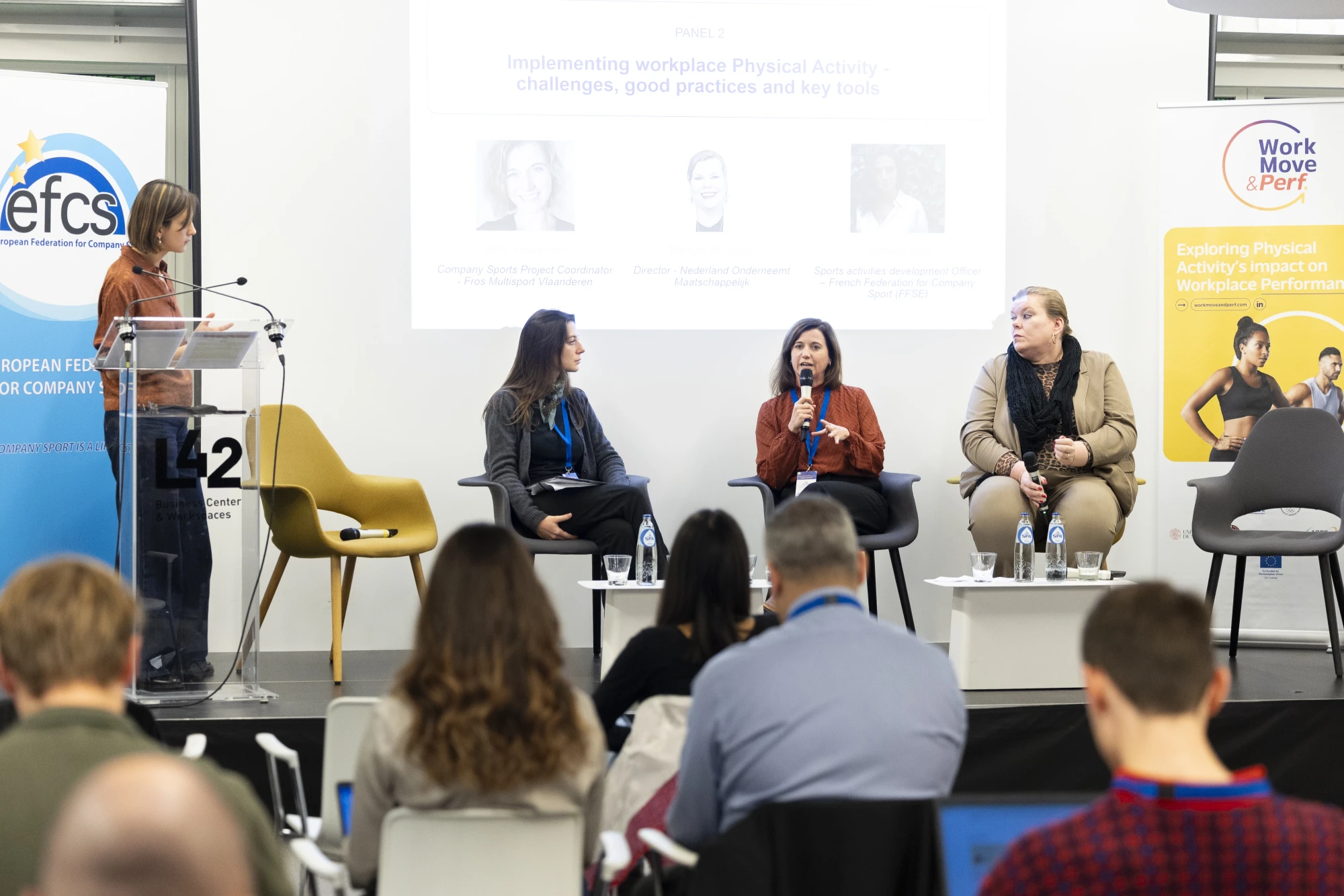
The second panel featured company sport ambassadors from France, Belgium, and the Netherlands, sharing practical insights:

Silke Veeckman, project manager at Fros Multisport Vlaanderen (Belgium), presented Belgian tools for needs analysis and evaluation, as well as an online platform to share best practices.

Martine Schuijer, director of Stichting Nederland Onderneemt Maatschappelijk! (Netherlands), highlighted linking physical activity with other health and inclusion priorities, and showcased free resources for national and European engagement.

Victoria Isitt, development officer at FFSE, shared her experience supporting companies, emphasizing the need for innovation and adaptation to new work realities, including remote work and multisite organizations.
Key takeaway: Scaling workplace physical activity requires clear tools, committed leadership, and strategies adapted to different organizational contexts.

The final panel looked beyond the projects, toward a structured European community:


Aurélia Fischer & Alister Dalrymple, vice president and secretary general, Swiss Federation for Company Sport / Evaleo, presented updates to Active Workplaces Certification criteria, integrating physical activity into CSR strategies.

Simon De Coster, international projects officer, Sport Vlaanderen, shared preliminary findings from a European report on government-led workplace physical activity initiatives.

Vincent Fohal, sports project officer, Municipality of Ixelles, illustrated the role of public authorities in driving active workplaces, with Ixelles being an Active Workplace-certified municipality since 2021.
Message: Sustainable impact relies on cooperation, shared commitments, and common tools, from local to European levels.

Active break
Just a few minutes of movement can help reconnect and relax: participants enjoyed an active yoga session led by Charlotte Frueh-Richardot.


Next steps: free resources to take action
This final conference marked the conclusion of a key phase and the launch of a legacy for research and cooperation projects. To develop more active workplaces across Europe, a full set of practical and accessible resources is available:

Studies and infographics
On the impact of physical activity on employee productivity and organizational performance:

E-learning platform (MOOC)
with insights, tools, and success factors for effective workplace physical activity programmes:

Open access to Active Workplaces Certification criteria
allowing organizations to assess and benchmark their initiatives:
Move at Work supporters’ pledge
inviting organizations and individuals to promote workplace physical activity based on Copenhagen Consensus principles:
Revoir la conférence en replay
These resources provide practical tools for transforming workplaces into active, healthy, and high-performing environments, enhancing employee health, well-being, and productivity.
Thank you to all speakers, partners, and participants for supporting more active, healthier, and high-performing workplaces in Europe.
The Move At Work (M@W) project, coordinated by the European Federation for Company Sport (EFCS), is co-funded by the Erasmus+ Sport programme. It aims to democratize physical activity in the workplace by providing a European overview of workplace physical activity programmes and offering practical tools and guidance for their implementation.
The EFCS is implementing the project together with eight partner organizations: the European Network for Innovation and Knowledge (Netherlands), Evaleo (Switzerland), the Federation of the European Sporting Goods Industry (Belgium), the Sport and Citizenship think tank (Belgium), Stichting NLOM! (Netherlands), the University of Copenhagen (Denmark), and the World Federation for Company Sport (France).


The Work, Move & Perf (WMP) project, coordinated by the French Federation for Company Sport (FFSE), is also co-funded by the Erasmus+ Sport programme. It is the first European-level scientific study to analyze the effects of physical activity on individual productivity and organizational performance.
The FFSE is implementing the project with eight partner organizations: the University of Copenhagen (Denmark), the University of Murcia (Spain), the European Federation for Company Sport (France), the Association for Sport in Free Time (Bulgaria), the French National Olympic Committee (France), the Sports Association of the Bank of France (France), the Authority for Integrity in Maltese Sport (Malta), and the European Network for Innovation and Knowledge (Netherlands).